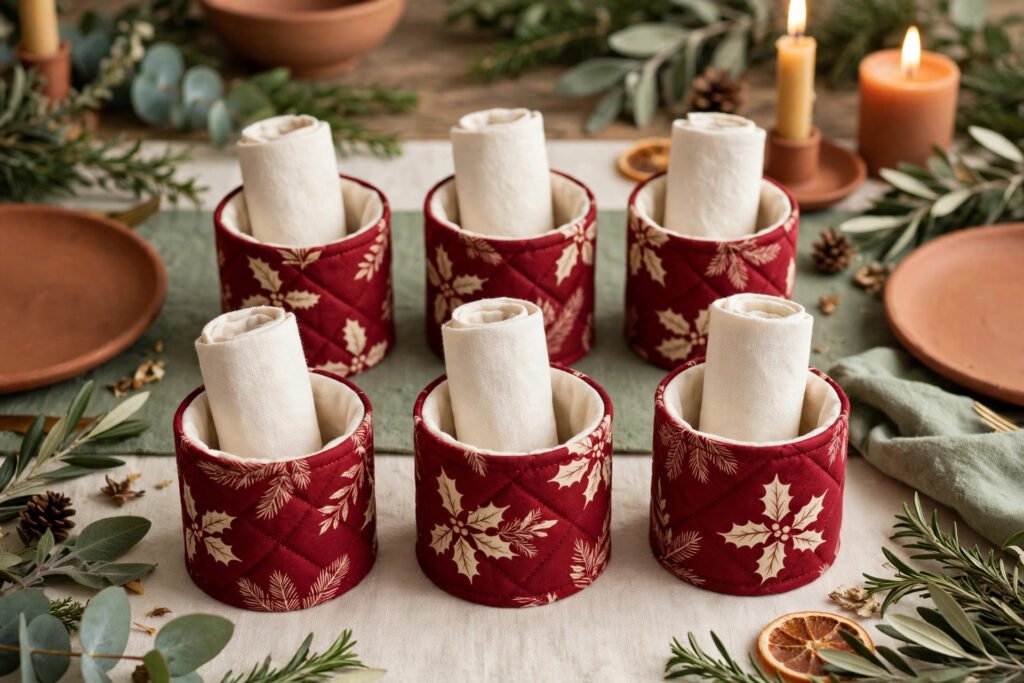
Why napkin rings punch above their size
A napkin ring is a tiny project with an outsized effect. One quilted ring turns a folded napkin into a place setting, and six of them turn a table into Christmas. Learning how to sew quilted christmas napkin rings is a perfect December project because it is quick, it uses scraps, and it teaches the same quilting and topstitching skills that larger projects need, without the commitment of a table runner.
The rings in this guide are made from a quilted band 20 cm long and 6 cm wide, which fits a standard rolled napkin snugly without gripping it so hard that the napkin tears when it is pulled out. A set of six covers most Christmas tables in one sitting, and the rings store flat between Christmases.
Choose fabric and batting for a ring that stands up
Quilting cotton and a firm hand
Choose quilting cotton for the outer band. It presses crisply, sews predictably, and comes in Christmas prints that read well even on a narrow band. A small or medium-scale print works best, because a 6 cm band will crop a large motif in strange places. A plain cream lining keeps the inside clean and makes the ring look finished from every angle, including from underneath, which guests will see when they lift their napkin.
Light batting, quilted close
For batting, use a light cotton batting, quilted with straight lines about 2 cm apart along the band. That close quilting is what gives the ring its body: an unquilted band flops, but a band quilted at 2 cm spacing stands round on its own. Do not use thick, high-loft batting, because it makes the ring puffy and hard to topstitch neatly, and a puffy ring will not sit flat on the table.
Cut bands and quilt them simply
Cut the outer fabric, batting, and lining all to 20 cm by 6 cm for each ring, using the same template for all six so the set matches. Cut all six sets at once if you can, and label them if you are using different prints, so you do not mix up bands. Press all pieces before you sew, because creases from the shop can make narrow bands harder to align, and on a 6 cm band there is nowhere for a crease to hide.
Layer each set with the outer over batting over lining, and pin every few centimetres so the narrow band cannot shift while you sew. Quilt straight lines 2 cm apart along each band, working from the centre outward. Straight-line quilting is the most forgiving choice here, and a walking foot helps feed the layers evenly, but a standard foot can work if you go slowly and pin well. Trim every quilted band to exactly 20 cm by 6 cm before joining, because a set only reads as a set when the bands match.
Join the bands into rings
Fold each band with its short ends together and sew the join, then press the seam open so the ring sits round instead of puckering at the join. A join pressed to one side will always show as a small bump, and on a small ring that bump is exactly where the eye lands. Pressing the seam open spreads the bulk evenly, and the ring will look round from every angle.
Finish the join neatly and press each ring, checking that the ring stands upright on its own before any topstitching. Topstitch both long edges of every ring, keeping the stitch line even all the way round, which also locks the join flat. Sew over the join twice: the join takes the whole strain every time a napkin is pulled through, and a single line of stitching at the join is the first thing to give way after a few Christmases.
The napkin test: snug, not tight
Slide your own rolled napkins through each ring and check they slide in without a fight but do not fall out when the ring is lifted. That is the fit you want: a napkin that stays put on the table but comes out cleanly at dinner, without tearing or leaving lint on the ring. Test with the thickest napkins you own, because a ring that fits a thin paper napkin may grip a thick linen one too tightly.
If a ring is too tight, check whether the band was trimmed short, or whether the join seam is bulky. If a ring is too loose, check whether the band stretched while quilting. Either way, fix the one ring before the set is finished, because a set of six with one odd ring will be the ring every guest notices. Press all six rings and stack them, checking that every ring measures the same and stands round without collapsing.
Make a set that matches, not just a pile
A set of napkin rings looks best when it is coordinated, not identical. Use the same lining and batting for all rings, and vary the outer prints within one colour family, such as red, cream, and pine green, or six different Christmas prints in the same tones. That variety makes the table interesting, while the shared lining keeps the set looking intentional and planned.
Make all the rings in the same sitting if you can, using the same thread, needle, and quilting spacing. That consistency is what makes a set look like a set, rather than a collection of single experiments.
Mistakes that spoil an otherwise good ring
Skipping the quilting
The most common mistake is skipping the quilting and making a simple fabric tube. A tube collapses, wrinkles, and looks homemade in the wrong way. The quilting is not decoration here: it is structure. Even two lines of quilting along the band will stiffen it noticeably, and four lines at 2 cm spacing will make it stand on its own.
Dress the table, then store the rings flat
Napkin rings are the fastest way to make a Christmas table look considered. Pair them with plain napkins and let the rings carry the colour, or pair them with patterned napkins and keep the rings in a single coordinating print. Either way, the rings should be the accent, not a competition with the rest of the table. Keep the rest of the setting simple, and the rings will do the festive work on their own.
Store the rings flat, stacked, not crushed into a bag, so they keep their round shape between Christmases. A small box with tissue between the layers will keep the quilting crisp for years. If a ring loses its shape in storage, press it from the back with steam and a pressing cloth, and it should spring back to round.
For a matching table, the same quilting and topstitching skills carry over to the How to Sew Reusable Fabric Gift Wraps guide, where a quilted square becomes wrapping that gets used again next year. For the full set with a printable template, the Quilted Christmas Napkin Rings Sewing Pattern gives you a full illustrated PDF instant download, with the 20 cm band template at true size and every step diagrammed.
A small project with a table-sized payoff
Napkin rings are one of the quickest Christmas sewing projects, and they change a table faster than almost anything else you can make in an afternoon. The bands are simple, the sewing is straightforward, and the result is visible at every place setting.
Ready to start? Choose a small-scale print, quilt the bands closely, press the joins open, and test every ring with a real napkin. Make a set for yourself, make a set for a gift, and keep the method in mind for next year. Once you can make a round, firm, well-finished ring, you have the core skills for larger quilted projects, from coasters to table runners and beyond.
Ready to sew the set? Get the Quilted Christmas Napkin Rings Sewing Pattern and read How to Sew Reusable Fabric Gift Wraps next.